Last updated November 17, 2026

Free written scope consultation - allowances, timeline, and change-order rules on paper before a single trade is scheduled
DIY vs Professional Bathroom Remodeling: What’s Safe to Do Yourself
In Miami-Dade County, unpermitted bathroom plumbing discovered at resale can require opening walls so an inspector can see the work and sign off on it. That remediation runs $4,000 – $9,000, and it lands in a disclosure conversation that erases years of DIY savings in an afternoon. The interesting part is that this rarely happens to people who lacked skill. It happens to people who picked the wrong task. This guide separates bathroom work by permit threshold and failure cost rather than by how handy you are, with the Miami-Dade code sections that govern each one and the numbers attached. We’ll show you what’s genuinely safe to take on in a Hialeah home and where the line sits.
Quick Answer
Painting, hanging mirrors, swapping cabinet hardware, and replacing a toilet or vanity top on existing supply lines are safe to do yourself. Anything that touches the plumbing rough-in, moves a drain or supply line, adds an electrical circuit, or changes the waterproofing envelope in a wet zone needs a permit and usually a licensed trade. The deciding factor is whether the task triggers an inspection, not whether you can physically complete it.
Styles & brands we work with
- Kitchen remodeling
- Bathroom remodeling
- Home additions & ADU
- Roofing
- Windows & doors
- Driveway & pavers
- Fence
Table of Contents
- The Permit Threshold: Where DIY Stops Being Smart
- Task-by-Task: Permits, Licensing, and DIY Failure Cost
- The Miami-Dade Code Sections That Govern Bathroom Work
- The Insurance Gap on Unpermitted Plumbing
- Genuinely Safe DIY Tasks (and What They Save)
- Hybrid Projects: Doing Your Own Finish Work After Rough-In
- Common Mistakes to Avoid
- When to Call a Professional
The Permit Threshold: Where DIY Stops Being Smart
Skill and legality are two different questions, and homeowners consistently conflate them. A confident DIYer can sweat a copper joint and still create a problem, because the joint isn’t the issue. The issue is that the work is now buried inside a wall with no inspection record behind it, and every future buyer’s inspector knows how to spot the absence. The permit threshold exists to create that record, not to keep you out of your own bathroom.
In Hialeah and across Miami-Dade, the threshold falls at three points:
- Any change to the plumbing rough-in – moving a drain, relocating a supply line, adding a fixture in a new location. A like-for-like toilet swap is not a rough-in change. Pulling the toilet to move it six inches is.
- Any new or relocated electrical circuit – adding a GFCI outlet, moving a vanity light, installing a heated floor. Replacing an existing fixture on an existing circuit is different from adding load.
- Any alteration to the waterproofing envelope – a shower pan rebuild, a tub-to-shower conversion, tile removal that disturbs the membrane beneath. This is the one homeowners underestimate most, because it looks like cosmetic work right up until the membrane is compromised.
Below that line, the work is generally yours to do. Above it, the code wants a paper trail, and the paper trail is what protects your resale value. In our experience across Hialeah, the cost of pulling the permit on a bathroom rough-in is small next to the cost of discovering at closing that it was never pulled.
Task-by-Task: Permits, Licensing, and DIY Failure Cost
Here’s the comparison most guides skip. The failure cost column is what it typically takes to correct a botched version of that task, not what the task costs to do right.
| Task | Permit Required | Licensed Trade Required | Typical DIY Failure Cost |
|---|---|---|---|
| Interior painting | No | No | $150 – $400 (redo labor and materials) |
| Tile on existing sound substrate | No | No | $600 – $1,800 (removal and reset) |
| Vanity swap, existing supply and drain locations | No | No | $300 – $900 (cabinet damage, minor leak repair) |
| Toilet replacement, like-for-like | No | No | $250 – $700 (wax ring failure, subfloor water damage) |
| Shower valve cartridge replacement | No | No (cartridge only) | $400 – $1,200 (valve body damage, wall opening) |
| Shower valve body replacement or relocation | Yes | Yes – plumbing | $2,500 – $6,000 (opening walls, re-inspection) |
| Full plumbing rough-in (drain/ supply relocation) | Yes | Yes – plumbing | $4,000 – $9,000 (demolition to expose for inspection) |
| Electrical circuit addition or relocation | Yes | Yes – electrical | $1,200 – $3,500 (rewire, panel correction) |
| Shower pan and waterproofing rebuild | Yes | Yes in most cases | $3,000 – $7,500 (full tear-out and redo) |
Read the table by the right-hand column. The tasks at the top are cheap to get wrong and easy to redo. The tasks in the middle and bottom are the ones where a single mistake can cost more than the original licensed job would have. That gap is what this guide is really about. If you want the full view of everything a bathroom project can involve, our Rowan Construction Group Hialeah home page lays out the trades we work across.
The Miami-Dade Code Sections That Govern Bathroom Work
Miami-Dade follows the Florida Building Code, and specific sections control bathroom work. You don’t need to cite these to your tile supplier, but knowing the section number helps when a contractor tells you a permit isn’t needed.
Plumbing. The Florida Building Code, Plumbing volume, Chapter 4 governs fixtures and fixture clearances, and Chapter 7 governs sanitary drainage. Chapter 7 is where drain relocation lives – the section that makes a moved drain an inspected event. Shower valve and mixing valve work falls under Chapter 4, with anti-scald requirements for the valve itself.
Electrical. The Florida Building Code, Electrical volume, Chapter 2 covers receptacle requirements in wet and damp locations, and Chapter 4 covers GFCI protection. Hialeah bathrooms require GFCI protection on all 125-volt receptacles in the bathroom, and it must be accessible. This is why a homeowner adding a vanity outlet without a permit and without GFCI protection is creating a genuine shock hazard, not just a paperwork problem.
Building. The Florida Building Code, Building volume, Chapter 12 covers interior finishes and waterproofing requirements in wet areas. This is the chapter that matters in a shower rebuild, and the chapter most often violated in DIY wet-zone work.
Permit fees. In Miami-Dade and Hialeah, a residential bathroom permit for plumbing and electrical typically runs $250 – $650 depending on scope, valued against the project cost. A combination permit that includes building, plumbing, and electrical can run $600 – $1,200 on a full rebuild. Compare those numbers to the failure costs in the table above and the economics are not close.
The Insurance Gap on Unpermitted Plumbing
This is the part most homeowners never think about until it matters. A standard homeowner’s policy generally covers sudden and accidental water damage. It typically does not treat damage the same way when the cause was work done without a permit, or when the work fails a code requirement that an inspection would have caught.
Here’s how it usually plays out. A supply line fails under a vanity and water spreads into the subfloor. The adjuster opens a claim and asks for the plumbing inspection record. There isn’t one. The policy may cover part of the repair, may deny the claim as unrepaired faulty workmanship, or may require you to demonstrate that the plumbing was installed to code before they’ll proceed. In practice, we’ve seen policies pay a portion of the resulting water damage while declining to cover the correction of the plumbing itself, which is the expensive half.
On a licensed, permitted install, the record exists. There’s an inspection card and a signed permit close-out, and the conversation at claim time is much shorter. Licensed plumbing also carries liability that the plumber’s own insurance backs, so if the joint fails, there’s a second party who shares responsibility. That’s the gap: a licensed job shifts risk off you, and unpermitted work leaves it squarely on your policy.
Roofing, additions, and exterior work follow the same logic. Our pages on Home Additions & ADU in Hialeah explain how permits protect a project’s resale value when the scope gets larger than a bathroom.
Genuinely Safe DIY Tasks (and What They Save)
There’s plenty of bathroom work worth doing yourself, and it’s the work that doesn’t touch a wet zone or a wire. Here’s where DIY pays off in a Hialeah home:
- Painting. A 5′ x 8′ bathroom takes roughly a gallon of paint and a weekend. Cost done yourself is $60 – $120 in materials; a professional repaint of the same room runs $400 – $900. This is a genuine saving with no code exposure. In Hialeah’s humidity, use a bathroom-rated semi-gloss or satin and plan on a re-coat every few years.
- Accessory installation. Towel bars, toilet paper holders, shower caddies, and robe hooks. A set of these costs $50 – $200 in materials and one afternoon of work. Anchor into studs where you can; Hialeah’s interior walls are usually drywall over furring or block, and block needs a masonry bit and a plastic anchor.
- Mirror hanging. A vanity mirror runs $80 – $400; hanging it yourself saves $100 – $250 in labor. Use a French cleat or two concrete-rated fasteners and check the wall type first.
- Cabinet hardware. New pulls and knobs on vanity cabinets take about 90 minutes, cost $40 – $150, and change the whole look of the room. Measure twice for the drill holes – the failure mode here is cosmetic, not structural.
- Caulk replacement. Stripping old silicone around the tub and re-sealing with a fresh bead is a $15 material job that prevents water infiltration at the most vulnerable joint in the room. Do this once a year in Hialeah, where the humidity works on that seam year round.
None of these tasks affect the waterproofing envelope, the plumbing, or the electrical, which is why none of them carry permit risk. If you want to add exterior work to a whole-house refresh, our Fence Installation in Hialeah team can talk through what makes sense there.
Hybrid Projects: Doing Your Own Finish Work After Rough-In
This is the arrangement we get asked about most, and it works well when the boundary is written down. The homeowner does the finish work – paint, tile, hardware, trim – and a licensed trade handles the rough-in: plumbing relocation, electrical, waterproofing, and inspection.
What makes a hybrid project go smoothly is having a signed scope boundary document that explicitly says who does what. It looks like a one-page addendum to the estimate, and it names each task and assigns it:
- Demolition: homeowner, with disposal responsibility stated in writing.
- Plumbing rough-in: licensed plumber, permit pulled by the contractor.
- Electrical and GFCI: licensed electrician, permit pulled.
- Inspection scheduling and sign-off: contractor’s responsibility.
- Cement board and waterproofing membrane: contractor. The membrane is the highest-risk single item in the room, and we don’t accept hybrid terms where the homeowner installs it.
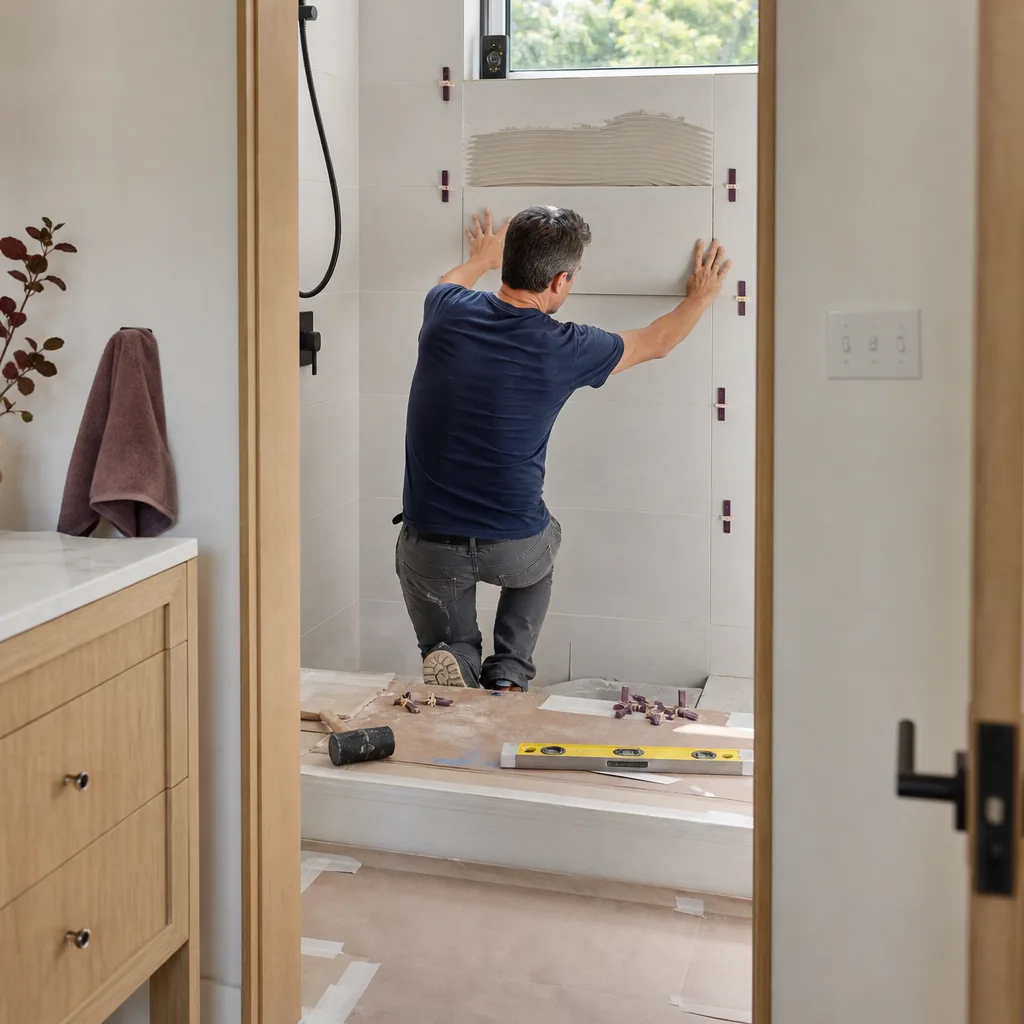
- Tile setting, painting, vanity install, hardware: homeowner.
- Punch list and final walk: joint, with a written record of what remains.
Rowan’s approach to every job starts with a flat written price and written scope before anyone picks up a tool, because that’s the document that keeps a hybrid project from turning into a blame conversation later. No change proceeds on a hybrid job without a signed change order, which is the administrative rule that has kept our projects within a few percent of the agreed cost across 4,000-plus jobs. When the homeowner wants to take on more, we revise the scope on paper and re-price before the work changes. If you’d like a second opinion on a quote from another contractor, the review is free.
There’s a related pattern in exterior projects, and our Driveway & Pavers in Hialeah page covers how the same boundary logic applies when homeowners want to do their own finish work on a hardscape.
Common Mistakes to Avoid
- Assuming a permit is only for structural work. A moved drain is not structural, and it still needs a permit and an inspection in Miami-Dade. Homeowners who conflate “structural” with “permit required” are the most common source of unpermitted plumbing we see in Hialeah.
- Skipping the waterproofing membrane to save a weekend. Tile over green board without a proper membrane in a wet zone will fail, and it fails on a delayed schedule – usually two to four years, well after the project looks done. In Hialeah’s humidity, that timeline shortens.
- Treating a shower valve cartridge and shower valve body as the same job. A cartridge replacement is a homeowner task. Replacing the valve body behind the tile requires opening the wall and re-inspecting, and it’s a plumbing job. The two look similar right up until the wall comes open.
- Running a new vanity outlet without GFCI. Florida code requires GFCI protection on bathroom receptacles, and a bathroom outlet without it is a real electrocution risk near water, not just a code technicality.
- Using drywall in a shower surround because it’s cheaper than cement board. Drywall in a wet zone absorbs moisture and pushes it into the framing behind. By the time the tile shows movement, you’re looking at framing repair, not a tile fix.
- Forgetting that Hialeah’s interior block construction affects anchoring. Hanging a mirror or a shelving unit on hollow block without the right fasteners can fail without warning. This is a small mistake with a heavy consequence.
- Doing the tile work before the plumbing inspection passes. We’ve seen homeowners set tile over a shower pan before the inspection, then have to pull the tile back up to give the inspector access. The sequencing matters as much as the work.
When to Call a Professional
Call a licensed trade when the work crosses the permit line, when the failure mode is buried behind a wall, or when the insurance exposure is bigger than the labor savings. In practice that means a plumbing rough-in, a drain relocation, an electrical circuit addition, a shower pan rebuild, or any waterproofing envelope work. A licensed plumber’s liability and a permit’s inspection record are the two things a DIY job can’t replicate, and on those tasks the record is worth more than the savings.
Rowan Construction Group Hialeah offers free estimates in Hialeah, and every quote is a flat written price with a written scope before work begins. Our technicians have up to 19 years of experience, and crews are background-checked and uniformed. If you’re holding another contractor’s quote, bring it in for a free second opinion – we’ll review it line by line. Call (888) 836-5914 to schedule your free estimate.
See the difference
 Before
 After
 Before
 After
 Before
 After
Frequently Asked Questions
Yes, for cosmetic and finish work – painting, tile on a sound substrate, vanity and toilet replacement on existing connections, hardware, and accessories. You need a permit the moment the work touches plumbing rough-in, adds or relocates an electrical circuit, or alters the waterproofing envelope. Miami-Dade inspections exist to create a record that protects your resale, and the permit fee on a bathroom is far smaller than the remediation cost if the work is discovered unpermitted later. Call (888) 836-5914 for a free estimate if you’re unsure where your project falls.
A cosmetic refresh runs $4,000 – $12,000, a mid-range full remodel runs $18,000 – $35,000, and a high-end rebuild runs $40,000 – $70,000, depending on tile, fixtures, and whether the plumbing or electrical is being relocated. The two items that move the price most are a drain relocation and a shower pan rebuild, because both need permits and inspection. Call (888) 836-5914 for an exact quote – estimates are free and written.
Sometimes, but usually not the full amount. Policies typically cover sudden accidental water damage while declining to cover correction of the plumbing that caused it, especially when the work was unpermitted. A licensed, permitted install creates an inspection record and shifts some of the liability to the plumber’s insurance, which is the difference that matters at claim time. Call (888) 836-5914 for a free estimate on getting the plumbing done to code.
A cartridge replacement swaps the internal part that controls temperature and flow, and it’s a homeowner task once the water is shut off. Replacing the valve body means opening the wall, cutting and re-soldering supply lines, and re-inspecting, which is a licensed plumbing job. The failure cost difference is $400 versus $2,500 on a botched job. If you’re not sure which you’re facing, call (888) 836-5914 and we’ll tell you what the work actually is.
Yes, to both. Moving a toilet is a drain relocation under the Florida Building Code, Plumbing volume, and adding a vanity outlet is a new circuit under the Electrical volume, which also requires GFCI protection in Hialeah. Both are inspected events, and both are the kind of work that creates the insurance gap we described if done without a permit. Permit fees for these run $250 – $650 in Miami-Dade.
Yes, and it’s a common arrangement in Hialeah. The key is a signed scope boundary document that says exactly who does what and who pulls which permits. We don’t accept hybrid terms where the homeowner installs the waterproofing membrane, because that’s the single highest-risk item in the room. Every change is documented with a signed change order before it proceeds. Call (888) 836-5914 to talk through a hybrid scope and get a written price.
The Bottom Line
The right question isn’t whether you’re handy enough to remodel a bathroom. It’s which tasks carry permit exposure, insurance liability, or buried failure modes that cost more to fix than the licensed job would have cost to do right. Painting, hardware, accessory installation, and like-for-like fixture swaps are yours to do and worth $1,000 – $2,500 in labor savings on a typical Hialeah project. Drain relocation, electrical circuit additions, waterproofing, and shower valve body work belong with a licensed trade and an inspection record. Rowan Construction Group Hialeah writes the price before anyone picks up a tool, backs every job with the 365-Day Done Right Promise, and delivers a documented photo record on every visit. Call (888) 836-5914 to schedule your free estimate.
Written by the team at Rowan Construction Group Hialeah.